 EN |
 IT
 ES
 RU
 ZH
 HE

Buying a yacht in Florida: the $18,000 maximum tax and the rules for nonresidents
Published on
In Florida, anyone who buys a yacht pays a 6% sales tax, but with a cap: no more than $18,000, whatever the price1, 2. A $300,000 yacht and a $30 million one pay the same maximum tax. And nonresidents, under certain conditions, pay nothing at all. Here is how it works.

The $18,000 cap
The rule is in Florida law (section 212.05 of the Florida Statutes) and has been in force since July 1, 20101, 2:
- The tax on the sale or use of a boat in Florida may not exceed $18,000. The cap includes both the 6% state tax and any county surtax.
- At 6%, the cap is reached at a price of about $300,000. Above that, the tax does not grow.
- It also applies to yachts bought outside Florida and brought into the state, when use tax is due.
- It also applies to bareboat leases, but per payment: each monthly payment carries at most $18,000 in tax, every month.
- If you trade in your old boat, the tax is calculated on the price difference, still with the $18,000 cap.
There is also a cap for repairs: on each repair of a boat in Florida the tax may not exceed $60,0001. For a major refit, that can make a real difference.
Nonresidents may not have to pay the tax
The same law provides an exemption for buyers who are not Florida residents and buy a yacht from a registered dealer to take it out of the state1, 3. The conditions are precise:
- Affidavit to the dealer. At the time of purchase the buyer signs a sworn affidavit stating that they are not a Florida resident, that the boat will not be used for a business in Florida, and that they will send the required documents to the Florida Department of Revenue. If a company is the buyer, none of its officers may be a Florida resident. The affidavit form changed on July 1, 2024.
- Deadline to remove the boat. In general the boat must leave Florida within 10 days of purchase, or within 20 days after repairs are completed, if there are any.
- Yachts of 5 net tons or more. They can stay in Florida for up to 90 days with a Department of Revenue decal that the dealer affixes to the boat. Within 60 days of purchase you can apply for an extension decal, which costs $425 and gives another 90 days: 180 days at most in total.
- Documents to send after departure. Within 30 days of leaving Florida, invoices for fuel, dockage or repairs from outside the state, showing the hull identification number. Within 90 days, proof that the boat has been registered outside Florida, or at least the application for registration.
- No return for 6 months. If the yacht comes back to Florida within 6 months of departure, the exemption is lost.
If any of these conditions is not met, use tax is due, still capped at $18,000, and penalties may apply1, 2.
The flag: what to know if you are not a U.S. citizen
- U.S. flag. Under federal law, a yacht can be entered in the U.S. Coast Guard registry (a documented vessel) only if the owner is a U.S. citizen, or a company that meets specific citizenship requirements4. A foreign buyer usually registers the boat in their own country or under another flag.
- Cruising the U.S. under a foreign flag. Yachts from certain countries can obtain a cruising license from U.S. Customs, valid for up to one year. It allows them to move between U.S. ports without entry and clearance formalities at each port, as long as the boat is not used for business5. The list of countries includes, among others, Italy, France, Germany, the United Kingdom, Switzerland, Malta, the Marshall Islands and the Cayman Islands. It does not include, for example, Spain, Russia, China or Israel: yachts under those flags follow the normal rules for foreign vessels.
On Selected Luxury Invest
In the Yachts section of the site you will find our selected offers. For each one you can request information with the form on the page.
This article is for information only and is not tax or legal advice. The rules are those in force as of November 19, 2026. Before buying a yacht, ask an accountant and a maritime lawyer for advice. America Welcome Inc. is a branding and marketing company: it is not a broker or a yacht dealer.
Sources
- Florida Senate — Florida Statutes, section 212.05 ($18,000 and $60,000 caps, nonresident exemption, decals, 6-month rule)
- Florida Department of Revenue — TIP 10A01-07: Sales and Use Tax on Boats or Vessels Capped at $18,000 (county surtax, trade-ins, leases)
- Florida Department of Revenue — TIP 24A01-10R: new nonresident affidavit effective July 1, 2024
- U.S. Code, 46 U.S.C. § 12103 — General eligibility requirements for vessel documentation (Cornell Law School)
- Code of Federal Regulations, 19 CFR § 4.94 — Yacht privileges; cruising licenses (Cornell Law School)
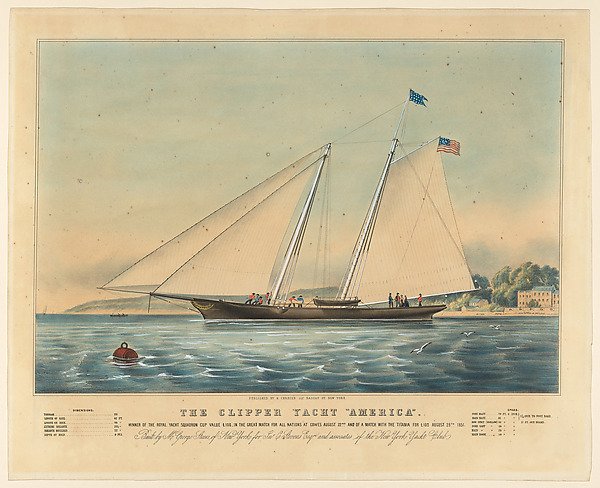
- The Metropolitan Museum of Art — Nathaniel Currier, “The Clipper Yacht ‘America’”, 1851
Images: Selected Luxury Invest archive; print of the yacht “America” — The Metropolitan Museum of Art (public domain).